The Self-Assembly Effect in Learning: Why Your Own Messy Notes Beat Polished Pre-Made Summaries
Downloading a gorgeous study guide from a top student feels like a shortcut—until nothing sticks on exam day. Here is why building your own notes wires far stronger memory.
Why Someone Else's Perfect Study Guide Fails You in the Exam
The person who built the summary did the real mental heavy lifting; passive readers skip the workout.
Your brain doesn't remember the prettiest page—it remembers the page you worked to assemble yourself.
Behavioral psychology shows people value and remember things they build themselves far more than ready-made versions. In learning science, this pairs with the Generation Effect: summarizing a dense paragraph into three personal bullet points forces genuine comprehension first.
Two Reasons Rough Personal Notes Win Every Time
1. Deciding What to Cut Builds Understanding
While drafting your own summary, you constantly evaluate which ideas matter and how concepts link together—the exact process that creates durable memory.
2. Your Own Wording Triggers Faster Recall
Examples and phrasing you choose yourself connect naturally to what you already know, whereas someone else's wording feels foreign and takes extra effort to memorize.
How to Use Pre-Made Guides Without Tricking Yourself
- Treat downloaded summaries as a final checklist after writing your own notes.
- Rewrite every key point from a pre-made guide in one plain sentence from memory.
- Attach one original example of your own to every abstract rule.
- Compress a 20-page handout into 3 tight pages of your own structure.

Draw Your Own Map
One rough summary you assembled yourself outperforms ten polished handouts.
Skip chasing aesthetic perfection—let ideas pass through your own thinking and typing so they actually stay with you when it counts.

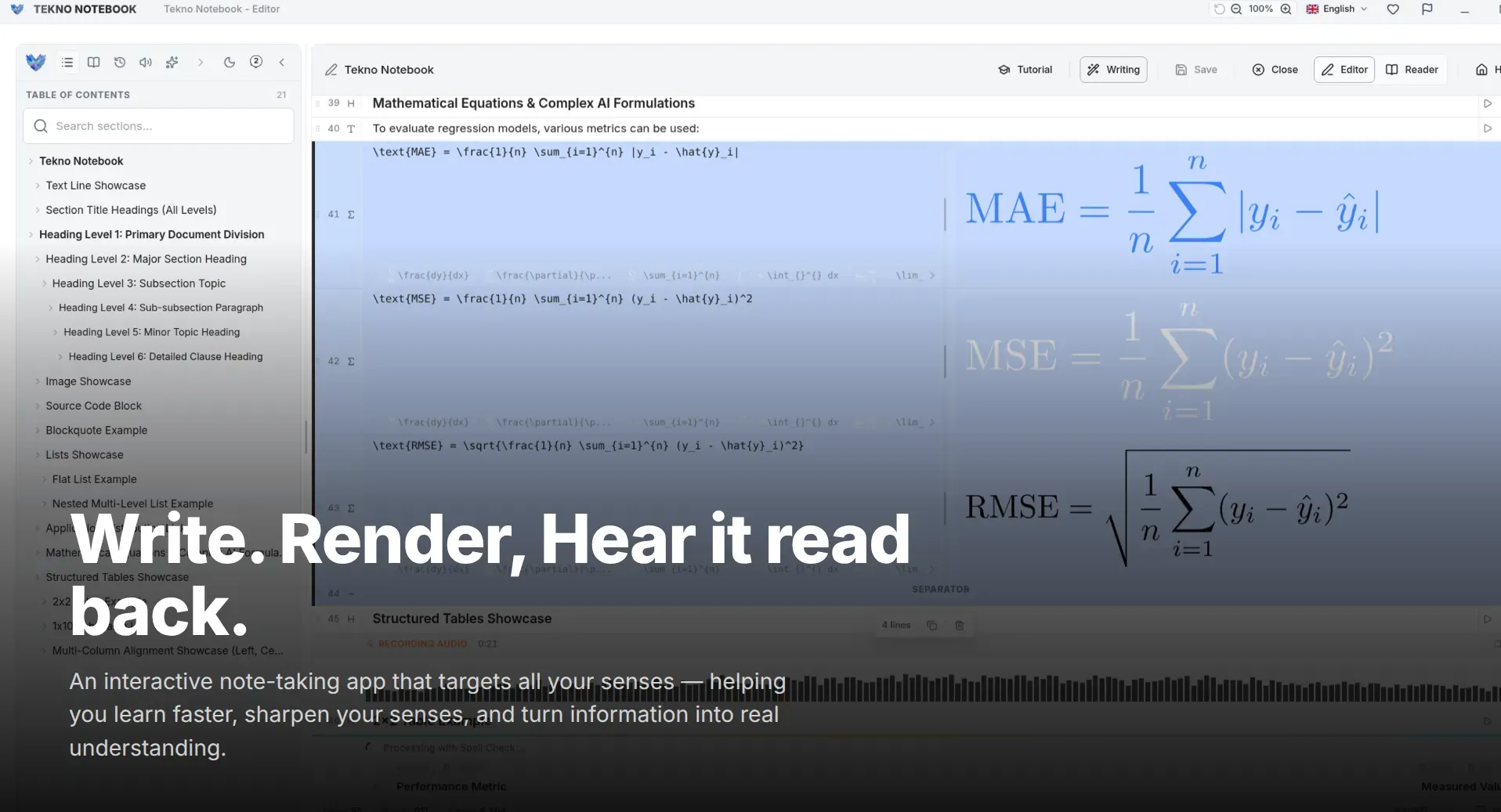
Tekno Notebook
Write Study and Technical Notes Without Clutter in Tekno Notebook
A local, offline-first desktop note-taking app with code blocks, live LaTeX equations, and built-in audio reading and dictation.
- 100% offline with full local ownership and zero tracking
- Native support for code snippets and live LaTeX math
- Built-in local Text-to-Speech (TTS) and Speech-to-Text (STT)
- Clean export to PDF, Markdown, and LaTeX