Pomodoro vs. Time Blocking: Which Focus Method Actually Works for Deep Studying?
A 25-minute timer helps you start, yet sometimes breaks your flow right when a hard problem clicks. Compare Pomodoro and time blocking to pick the right rhythm for every study session.
Why One Study Timer Never Fits Every Subject
Starting a boring task and solving a complex problem require completely different rhythms.
Many students try the classic 25-minute Pomodoro timer and feel frustrated when the alarm interrupts them right in the middle of a math proof or coding bug. Others schedule huge three-hour blocks, only to spend the first forty minutes procrastinating because the block feels overwhelming.
Neither method is broken—they simply solve different problems. Pomodoro lowers the barrier to starting when your energy is low, while time blocking protects long, uninterrupted stretches for analytical work that takes fifteen minutes just to warm up.
Three Practical Ways to Match Your Timer to the Task
1. Use 25/5 Sprints to Break Procrastination and Review Light Material
Short 25-minute intervals shine when you dread starting a reading assignment, organizing lecture notes, or reviewing vocabulary. Knowing a five-minute break is close makes it easy to begin.
2. Switch to 50/10 Blocks for Problem-Solving and Writing
When working through physics equations, lab reports, or programming exercises, a 50-minute block gives your brain room to reach full concentration before stepping away for ten minutes.
3. Use Time Blocking to Protect Your Peak Energy Hours
Instead of a vague to-do list, assign your hardest subject to a fixed two-hour window on your calendar—then run two 50/10 cycles inside it so you stay structured without burning out.

Five Rules for Focus Sessions That Actually Finish Work
Simple adjustments that turn timed sessions into real progress.
- Define one concrete output before starting the clock—such as summarizing two sections or solving five problems.
- Keep your phone in another room during the block; checking one message resets focus for minutes.
- Spend your break away from screens: stretch, walk, or drink water so your eyes and working memory reset.
- End every block by writing a one-line note of where to resume next time.
- Work inside a calm offline workspace so browser tabs and notifications never steal your block.
A timer cannot create focus on its own—it simply draws a clear boundary between real work and real rest.
Pairing Timed Blocks With an Offline Study Workspace
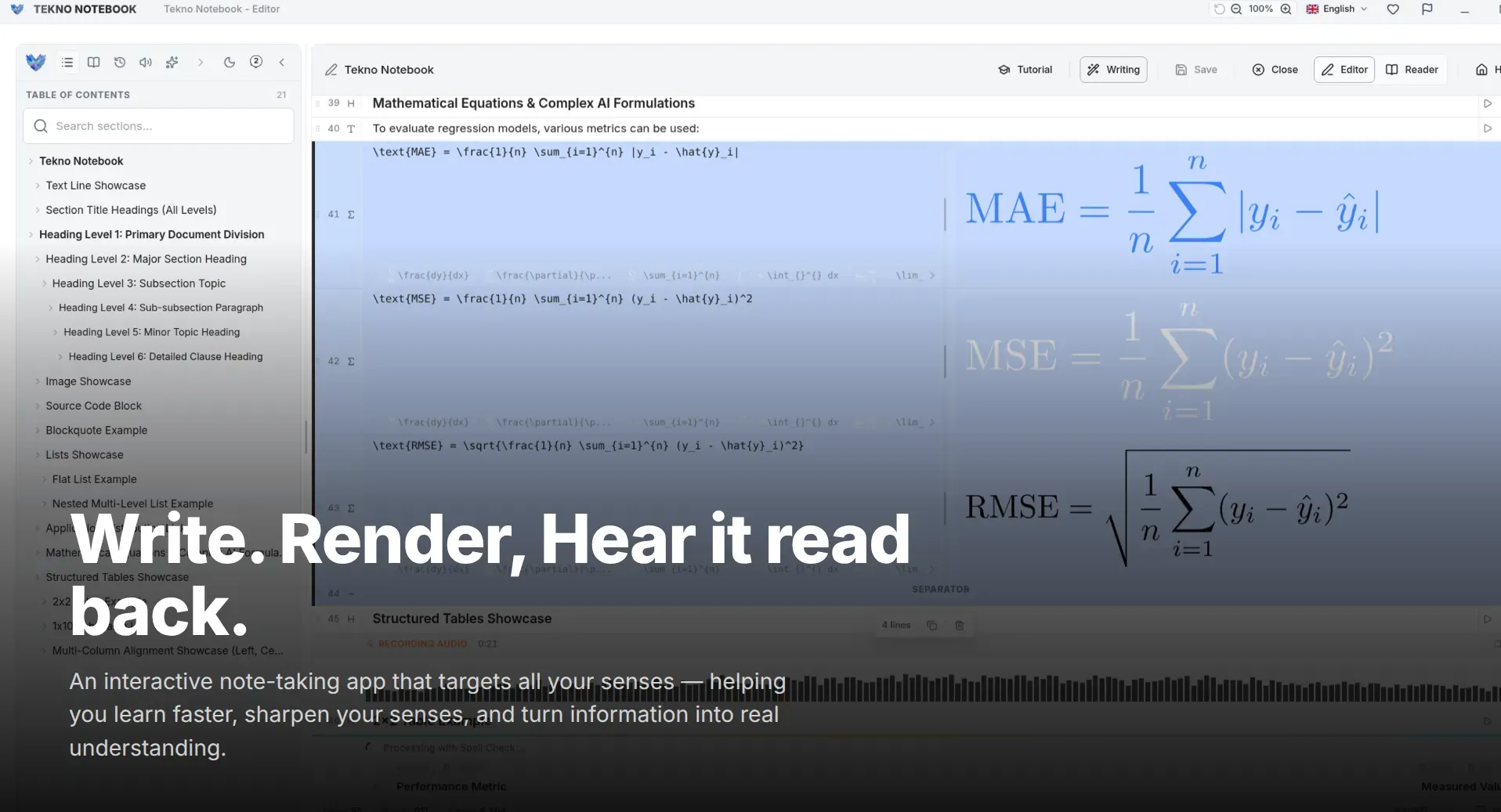
Even the best schedule collapses when your notes live inside a cluttered browser full of alerts. Keeping your summaries, equations, and quick voice memos offline inside Tekno Notebook lets you open one clean page when the timer starts, write without lag, and listen back to your session summary during a walk.
Try the hybrid approach tomorrow: reserve one 90-minute time block for your toughest subject, split it into two focused sprints, and write down one measurable goal before pressing start.

Tekno Notebook
Listen to Your Notes Like a Media Player and Retain Twice as Much
Transform static written notes into an interactive audio track. Tekno Notebook combines built-in Text-to-Speech, Speech-to-Text, and synchronized line highlighting in a distraction-free desktop app.
- Built-in media player with play, pause, seek, and playback speed controls
- Auto-Tracking highlights the exact sentence or line as it is read aloud
- Multilingual Text-to-Speech support including Arabic, English, Spanish, Portuguese, and Chinese
- Integrated Speech-to-Text (STT) for dictating quick insights directly into your notes
