Active Recall vs. Rereading: Why Highlighting Fails Before Exams
Rereading chapters feels productive, yet your mind goes blank in the exam hall. Learn how active recall strengthens memory and how to turn ordinary notes into self-tests.
The Fluency Trap: Why Familiar Notes Fool Your Brain
Recognizing a sentence on a page is not the same as retrieving it from memory.
Many students highlight half a textbook and read the same summary four times, only to freeze when an exam question asks them to explain a concept from scratch. Cognitive research calls this the illusion of competence: seeing a phrase repeatedly makes it feel familiar, so your brain mistakes recognition for true recall.
Active recall flips the process. Instead of pushing information into your head again, you force your brain to pull it out. Every time you struggle briefly to retrieve an answer and then verify it, you strengthen the neural pathway far more than another passive read-through ever could.
Three Ways to Turn Any Lecture Into Active Recall
1. Replace Static Headings With Direct Questions
Instead of writing a heading like "Photosynthesis Stages," write "What happens during the light-dependent stage and what does it produce?" When you reopen your notes the next day, every heading becomes a mini-quiz before you glance at the explanation underneath.
2. Practice Closed-Book Blurt Sessions
After finishing a short section, close your notes and write down or speak aloud everything you remember in three minutes. Then reopen your file and mark only the gaps you missed. Those exact gaps are where your next ten minutes of study belong.
3. Use Audio Playback as a Verbal Self-Quiz
Listening to a question prompt, pausing to answer out loud, and letting the rest of the note play back turns walking or commuting into genuine retrieval practice rather than passive background noise.

Five Rules to Make Active Recall Stick
Small habits that double retention without adding extra study hours.
- Test yourself before you feel completely ready; slight mental effort is what triggers stronger memory.
- Keep each question focused on one clear idea or formula rather than an entire chapter.
- Check your answer immediately so you never reinforce a wrong fact.
- Mix older questions with new ones so your brain practices choosing the right method.
- Keep your Q&A notes in one distraction-free offline workspace so revision starts in seconds.
If studying feels effortless, you are probably reviewing what you already recognize—not building the memory you need for exam day.
Building a Frictionless Recall Routine
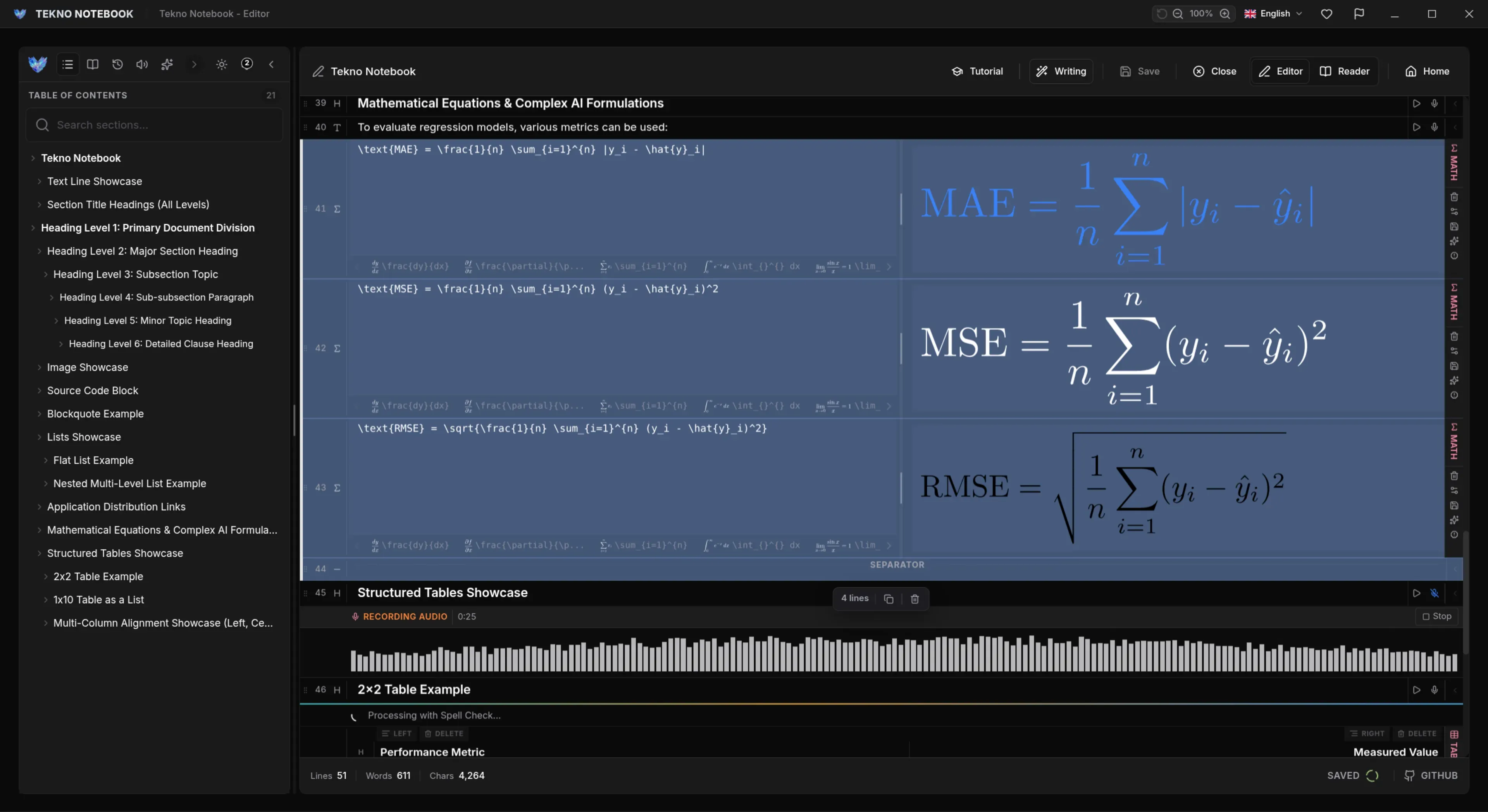
The biggest reason students slip back into passive rereading is friction: building separate flashcard decks takes hours. Writing your lecture notes directly in question-and-answer format inside Tekno Notebook removes that extra step, letting you collapse your focus to one clean offline page, dictate quick recall summaries with Speech-to-Text, and quiz yourself through Reader Mode whenever you want.
Start with just one chapter tonight: convert five headings into questions, close the screen, answer them from memory, and watch how quickly weak spots reveal themselves.

Tekno Notebook
Listen to Your Notes Like a Media Player and Retain Twice as Much
Transform static written notes into an interactive audio track. Tekno Notebook combines built-in Text-to-Speech, Speech-to-Text, and synchronized line highlighting in a distraction-free desktop app.
- Built-in media player with play, pause, seek, and playback speed controls
- Auto-Tracking highlights the exact sentence or line as it is read aloud
- Multilingual Text-to-Speech support including Arabic, English, Spanish, Portuguese, and Chinese
- Integrated Speech-to-Text (STT) for dictating quick insights directly into your notes