How to Learn Any Programming Language Faster and Escape Tutorial Hell
Watching 20 hours of coding videos will not teach you to build from scratch. Follow a practical project-first roadmap to learn any new programming language faster.
Why Watching Hours of Tutorials Leaves You Stuck on a Blank File
Shifting from passive watching to building small, real programs.
Almost every beginner knows the trap of tutorial hell: finishing a 15-hour video course feeling confident, opening a blank editor, and freezing on line one. Watching someone else solve bugs feels like learning, yet it never trains your own problem-solving muscle.
You do not need to memorize an entire language before building. Roughly 20% of the core syntax is enough to ship small projects and learn the rest on demand.
A Three-Stage Roadmap to Pick Up Any Language Fast
1. Learn Only the Shared Core in Week One
Focus strictly on the building blocks every language shares: variables, conditionals, loops, functions, lists/maps, and basic file reading. Skip obscure advanced features until a real project asks for them.
2. Build Three Tiny Projects Without Copy-Pasting
Start with a small CLI utility, then a personal task or file organizer, then a tiny tool that parses real data. Hitting real errors and fixing them teaches ten times more than smooth video walkthroughs.
3. Maintain Your Own Compact Language Cheat Sheet
Every time you solve a tricky error or write a clean pattern, log it in your own words. Keeping a fast offline cheat sheet inside Tekno Notebook turns every lesson into instant recall for your next project.


Five Rules to Learn Coding in Half the Time
Simple habits that turn theory into real skill.
- Follow a 30/70 split: 30% reading or watching, 70% writing and breaking code.
- Type examples yourself instead of blindly copying and pasting.
- Read error messages carefully—they usually tell you exactly what went wrong.
- Modify every tutorial example with one small feature of your own.
- Keep a personal log of recurring bugs and clean patterns in a local notebook.
You do not learn programming so you can build projects later—you build small projects to learn programming now.
Build a Personal Offline Syntax Reference
Instead of opening twenty browser tabs every time you forget a syntax detail, keep one clean personal reference per language.
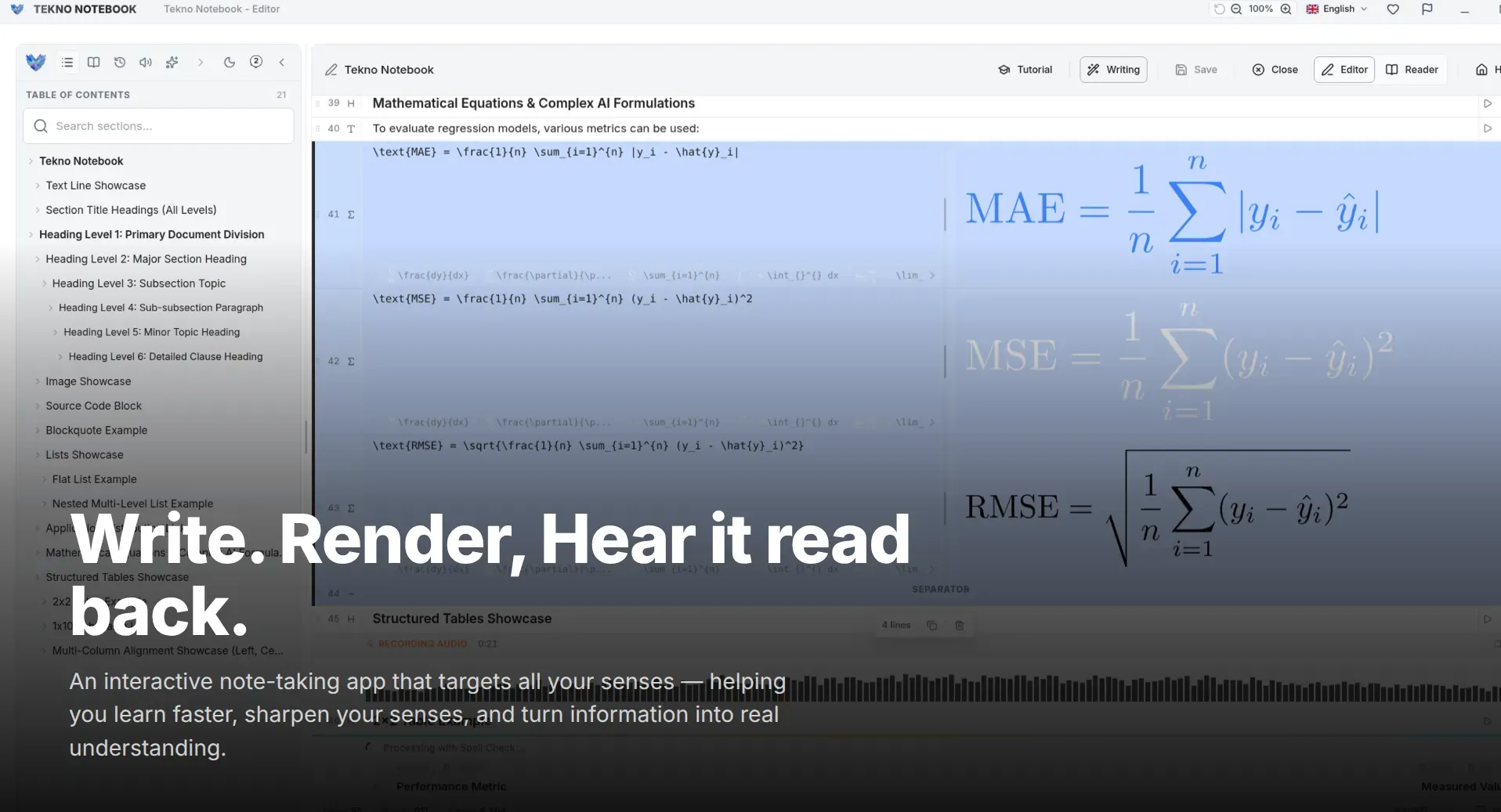
Tekno Notebook lets you store tested snippets, error fixes, and syntax summaries offline for instant lookup—and export clean PDF or Markdown guides anytime.

Tekno Notebook
A Quiet Desktop Notebook for Deep Study Sessions
A free offline desktop notebook with smart line detection, synchronized audio playback, speech-to-text dictation, and a built-in AI assistant, built for students who want to capture fast and review smart.
- Free offline desktop app with no tracking
- Reader Mode with an interactive table of contents for self-testing
- Smart Line Detection and keyboard-first shortcuts for fast capture
- Audio Reader that highlights each line as it is spoken