How to Memorize Fast and Never Forget: Beat the Ebbinghaus Forgetting Curve With the 1-3-7 Rule
Memorize a chapter today only to draw a blank tomorrow? Learn how the Ebbinghaus forgetting curve works and how five-minute reviews on days 1, 3, and 7 lock facts in.
Why You Forget Up to 70% of What You Study Within 24 Hours
Your memory is not broken—your brain is simply following the natural forgetting curve.
Fast memorization is not about rereading a page ten times in one night—it is about reminding your brain right before the memory fades.
Psychologist Hermann Ebbinghaus demonstrated that without timely reinforcement, the brain drops roughly 50% to 70% of newly learned details within the first day. That is why studying hard on Sunday can still leave you feeling like a stranger to the same chapter by Tuesday.
The 1-3-7 Review Rule to Flatten the Forgetting Curve
- Day 1 (same evening): Spend five minutes scanning your core summary to signal that the material matters.
- Day 3: Recall key definitions and formulas from memory first, then fix only the gaps.
- Day 7: Do a three-minute pass over the condensed note; retrieval will already feel almost automatic.
- Day 14 (pre-exam): One final light check moves the topic firmly into long-term memory.

How to Keep 1-3-7 Reviews Under Five Minutes a Day
Short, frictionless reviews are the only kind students actually stick with all semester.
1. Condense Every Lecture Into One Scannable Note
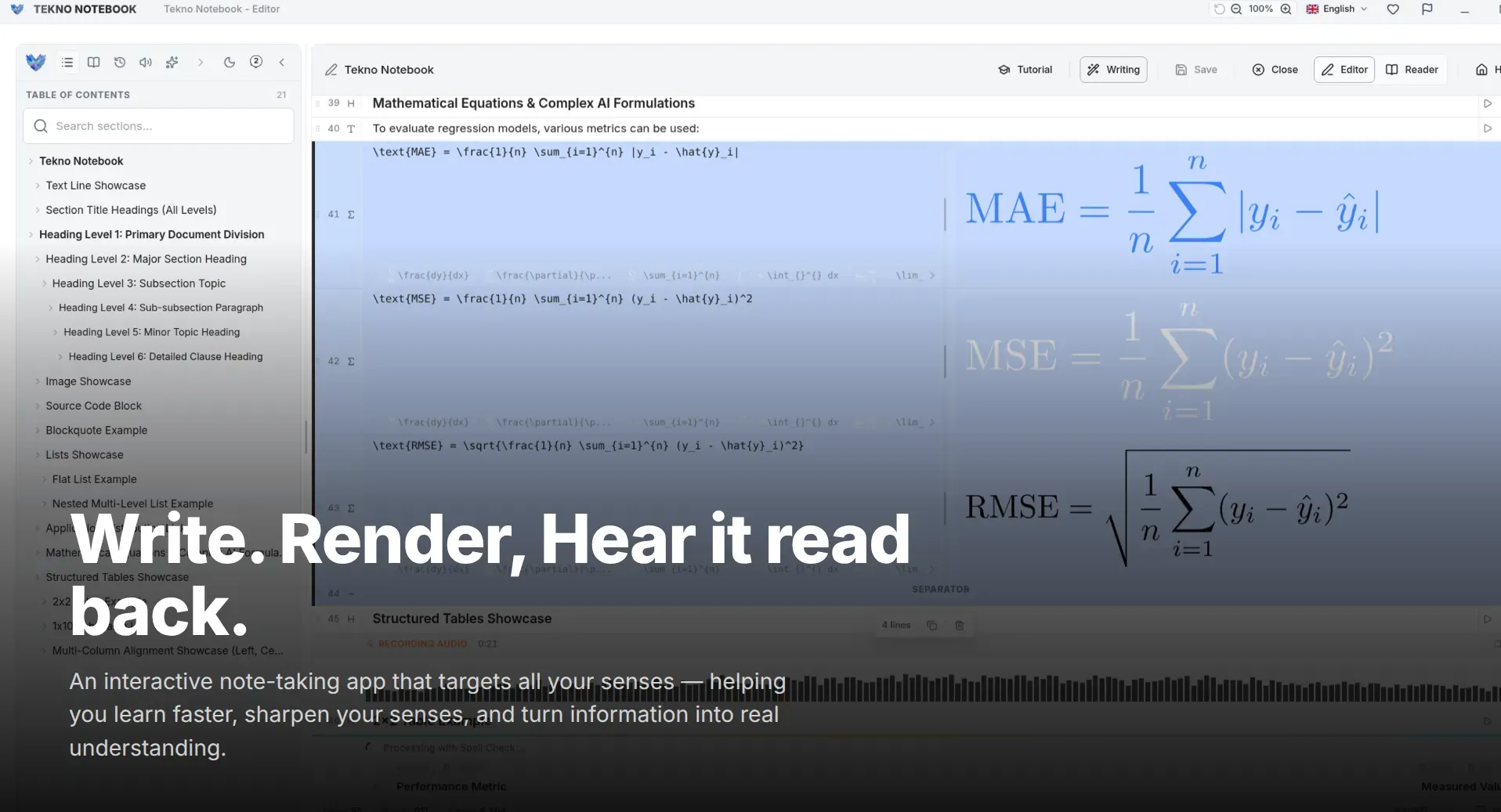
Instead of flipping through thirty textbook pages every review day, keep one sharp summary inside Tekno Notebook so Day 3 takes three minutes flat.
2. Listen to Your Day 3 and Day 7 Reviews Offline
When your eyes are tired, trigger Tekno Notebook's offline Text-to-Speech with automatic line tracking—reinforcing your memory by ear even while resting.

Tekno Notebook
Run 5-Minute Day 1, 3, and 7 Reviews Effortlessly in Tekno Notebook
Keep concise study summaries in Tekno Notebook and review them in Reader Mode or via offline Text-to-Speech so every lesson sticks before exam day.
- Offline Text-to-Speech replays Day 1, 3, and 7 notes aloud
- Distraction-free Reader Mode keeps key points crisp and scannable
- Native support for formulas, code blocks, and clean checklists
- 100% offline desktop app for Windows and Linux