AI Hallucinations Explained: Why Models Confidently Invent Facts—and How to Stay Accurate
AI can write a polished answer citing a paper or formula that does not exist. Understand why hallucinations happen in plain terms and how to protect your study accuracy.
The Model Is Not "Lying"—It Is Predicting What Sounds Right Next
Understanding how language models work turns you into a sharper user who never gets burned by fluent mistakes.
Fluent writing is not proof of truth—an AI model writes a wrong formula with the exact same confidence as a right one.
Students and professionals alike have experienced the shock: an AI response cites a realistic book title, historical date, or equation—only for a quick check to reveal it was completely fabricated. Known as AI hallucinations, these confident errors stem directly from how generative models operate.
Two core reasons hallucinations happen:
1. Probabilistic Word Prediction Instead of Fact Lookup
Under the hood, a language model predicts the most statistically plausible next token rather than querying a verified textbook. When details are sparse, it stitches together plausible-sounding patterns.
2. Trained to Be Helpful Even When Uncertain
Models are tuned to produce smooth, complete answers—so on niche course details or narrow specs, they often guess smoothly instead of admitting they do not know.
Four Habits That Keep Hallucinations Out of Your Study Work
- Never trust generated citations, dates, or statistics without checking the primary source.
- Cross-check every new formula or definition against your own class notes and textbook.
- Ask AI to explain concepts you paste in—rather than inventing facts from scratch.
- Keep your verified summaries stored locally in one tidy notebook you own.
Your Verified Notebook Is Your Best Anchor for Accuracy
The easier it becomes to generate text, the more valuable your own checked notes become.
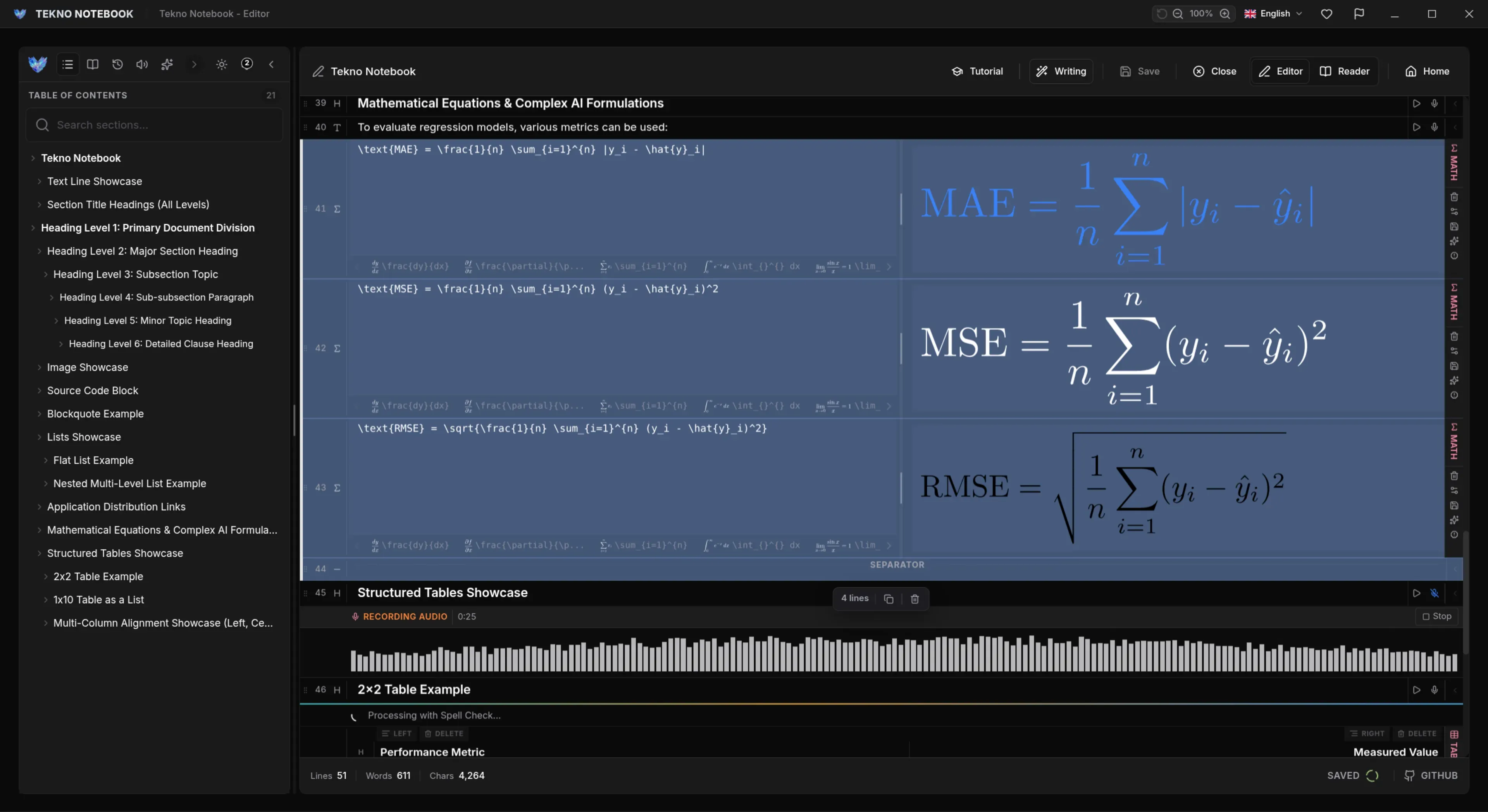
Building a clean offline library of checked definitions, LaTeX equations, and lecture summaries inside Tekno Notebook gives you a dependable reference you can read or listen to anywhere—free from surprise fabrications.
Treat fluent AI output as a rough draft, and let your verified personal notes remain the final word.

Tekno Notebook
Listen to Your Notes Like a Media Player and Retain Twice as Much
Transform static written notes into an interactive audio track. Tekno Notebook combines built-in Text-to-Speech, Speech-to-Text, and synchronized line highlighting in a distraction-free desktop app.
- Built-in media player with play, pause, seek, and playback speed controls
- Auto-Tracking highlights the exact sentence or line as it is read aloud
- Multilingual Text-to-Speech support including Arabic, English, Spanish, Portuguese, and Chinese
- Integrated Speech-to-Text (STT) for dictating quick insights directly into your notes